
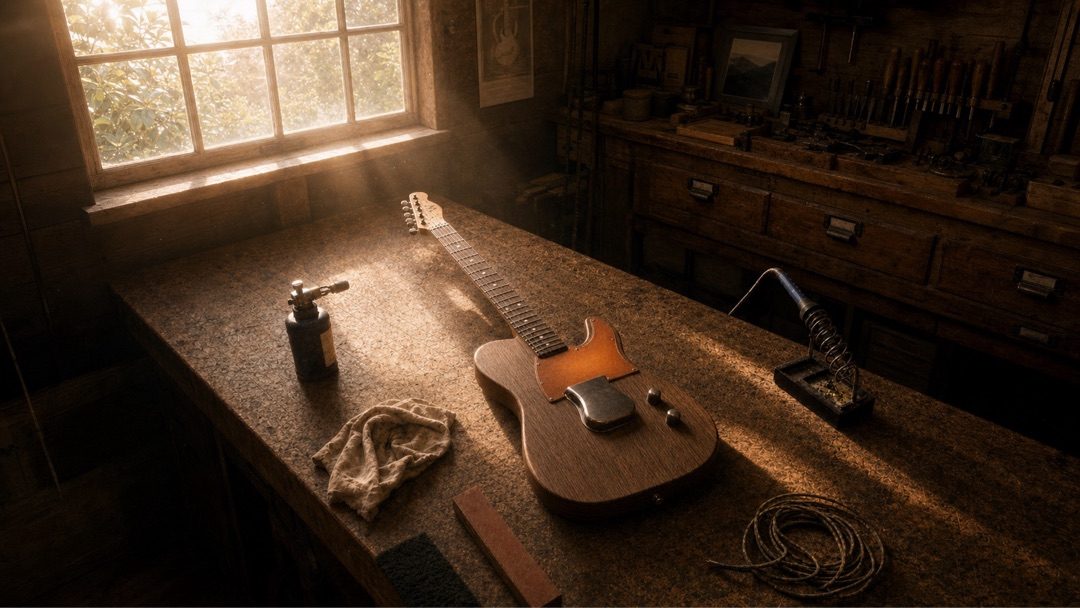
People ask how long a guitar takes, and they want a number. Twelve weeks, sixteen, something they can write down. I give them the number because they need one, but the number is a lie of convenience. The honest answer is that the guitar takes as long as the oil takes, and the oil cannot be rushed.
Tru-Oil goes on thin. You wipe it into the walnut with your hand, almost nothing, and then you wait. Wipe it back, let it cure, do it again. You cannot make it faster by wanting it faster. I learned that the hard way, the way I have learned most things, by trying to skip the part where you wait and ruining the work. A coat rushed is a coat you sand off, and now you have lost a day instead of saving an hour.
My grandfather, Jack Wimberly, spent his life at Hughes Tool in Houston. Steel and oil and the patience to let a thing be done right. I did not understand any of that when I was young and moving fast, a new town every morning, a guitar I would trade away by Christmas. I understood movement. I did not understand staying. It took me a long time and a hard road to learn that the things worth keeping are the ones that took their time, and that you cannot fake the time. You can only put it in.
So a walnut body sits on the bench under raking light and takes the oil one thin coat at a time, days of it, until the grain stops drinking and starts to glow from somewhere under the surface. The metal gets blued and worked almost dry, like a barrel. The leather gets cut and burnished and dyed by hand, dark at the edges to amber at the center, the same family as an old rifle stock. And last, into the maple headstock, one small W, burned with a hot iron. One guitar, one W, one place.
None of it can be hurried. That is not a flaw in the method. That is the method. The guitar is built to age honestly because it is built honestly, slowly, by two sets of hands in one shop, and you can feel the difference in your own hands the first time you pick it up.
Twelve weeks, then. Maybe sixteen. As long as the oil takes.
Preston