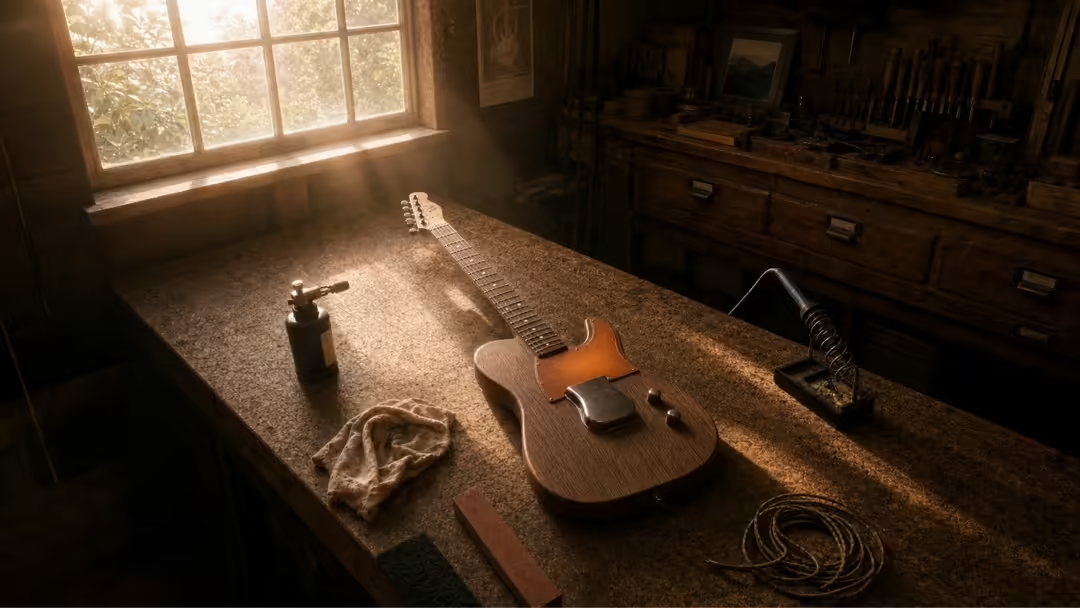
A father-and-son
workshop in Texas.
Electric guitars built by Preston and Jim Wimberly.

Preston and Jim Wimberly.
Preston Wimberly spent more than a decade as a professional touring guitarist: lead guitar for The Wild Feathers, signed to Warner Bros. Records, and later with Jamestown Revival. He played festivals, late-night television, theaters, and arenas across the United States and abroad.
Today, Preston and his father, Jim, build Wimberly guitars together in Texas. The instruments that held up through years of playing remain their reference point.
A letter.
I spent a long stretch in and around the music industry, on stages, in vans, in studios, in a new city most mornings. Signed to a major label. That life teaches you movement. Venues change. Sounds change. Bands change. Guitars come and go.
Over those years I came to value the instruments that stayed with me. They were made from real materials, by someone who cared, built to be played for a long time. They got better the more life they saw. The finish checked. The metal dulled. The neck wore in. Every mark was part of the record.
Now I build with my father, Jim. His father, Jack Wimberly, worked his whole career at Hughes Tool in Houston. Steel, oil, and patience were part of his working life. That inheritance belongs in the guitars.
My mother, Margie, was deeply involved in the equestrian world. The house I grew up in was full of saddles, tack, reins, and leather gear. She admired the craftsmanship in those pieces: the stitching, the hardware, and good leather that softened with use but still held its strength. That memory is part of why leather belongs here.

The work brings those references together: wood, metal, leather, and wire, built into guitars by my father and me.

Walnut and blued steel.
The reference object on the bench is a 19th-century lever-action rifle: oiled walnut, a case-hardened receiver, blued steel, and hand-fitted parts. Its materials and construction guide the work.
How a Wimberly is built.
From the walnut blank to final setup.
Wood
Solid walnut blanks selected for grain, density, and weight. The body is cut, carved, and sanded by hand. The neck is fitted to the body.
Oil
Tru-Oil is hand-rubbed into the wood in thin coats. Each coat is wiped, cured, and rubbed back over several days.
Leather
The Jack uses hand-dyed 8 oz vegetable-tanned leather with burnished edges. The Heirloom design carries the same amber-to-tobacco sunburst on 8 oz vegetable-tanned leather treated with neatsfoot oil, with one fine inset crease and a smooth burnished edge.
Metal
Steel is blued, blackened, or fire-colored. Nickel is JAX-blackened, lightly carded, and sealed. Brass is left raw.
Seal
Metal is protected with a thin oil or wax wipe, then worked almost dry.
Assembly
For The Jack, the pickup, Gunstreet 50s wiring harness, tuners, and bridge are installed. The harness is hand-soldered. The leather pickguard is fitted last. The Heirloom components will be confirmed through prototype work.
Mark
On The Jack, a small W is burned into the maple headstock face.
Setup
Frets are dressed. Action and intonation are dialed in. The guitar is played, adjusted, and played again, until it answers.


The W.
A small slab-serif W is branded into the maple with a heated iron. The scorch edge remains visible in the wood.
One W per guitar, small on the headstock face.

Vintage oval tuners.
The Gotoh-style machines are JAX-blackened, lightly carded, and sealed with a thin oil or wax wipe. The functional screws are gunmetal.
The wood is what it is. The steel takes blue and oil. The nickel takes blackener, carding, and oil. The leather darkens with use.Built to age, not to look old.
Join the build waitlist.
The Jack is made to order by Preston and Jim Wimberly. New Jack builds are currently waitlisted; once a slot opens, build time is 12–16 weeks from deposit to delivery. The Heirloom is our next model, with its single-cut design selected and prototype work ahead.